
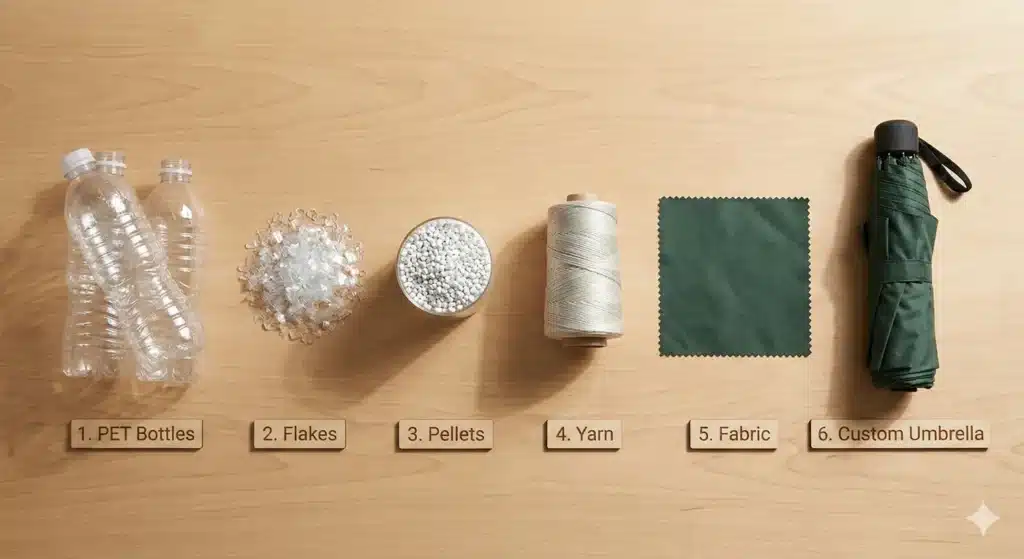
Direkte Antwort: printing sustainable umbrellas does not start with the word “eco”, but with a verifiable product specification. A buyer must record which part contains recycled material, what percentage is claimed, how the chain is documented, what printing and packaging are used and how long the product is expected to last. Then material, frame, handle, sample, quality control and communication can be assessed as a whole.
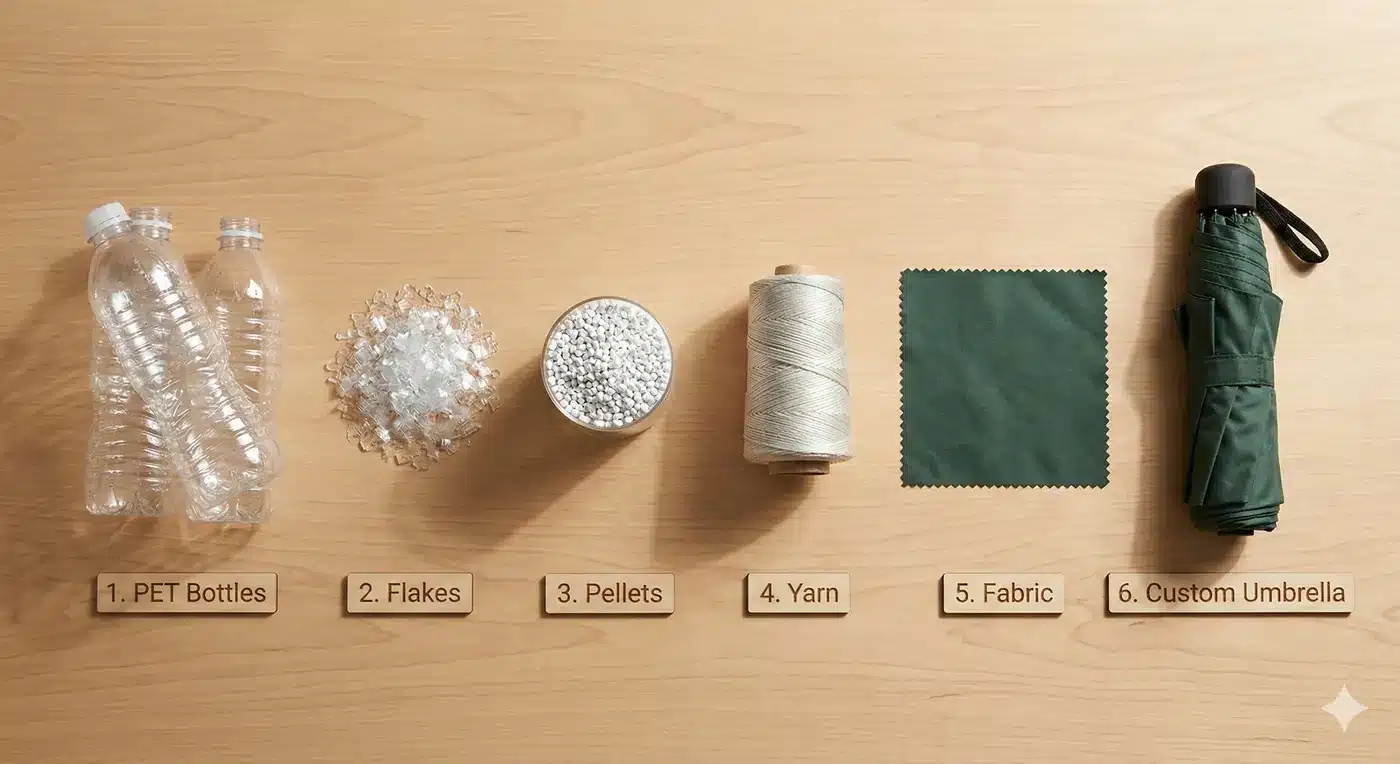
This guide is intended for Dutch brands, promotional gift suppliers, retailers, importers and sustainability or purchasing teams. The images come from Ark Umbrella’s real corporate archive and show RPET material, a product concept and a bamboo handle. No fixed MOQ, delivery time, certificate validity or environmental performance are promised; these must be confirmed per material, factory and order.
Start with the purpose of the order
An umbrella can be a promotional gift, retail product, personnel item, event product or part of a sustainable range. The goal determines how heavily material claims weigh, how visible the logo should be and what lifespan is appropriate. A cheap disposable item with a green label is not a strong sustainability strategy.
Therefore record use, target group, distribution, desired useful life, price level and order volume. The umbrella manufacturer page of Ark Umbrella is the commercial starting point for OEM, private label and printed umbrella projects.
Define what “sustainable” means in this project
Sustainable can refer to recycled cloth, a replacement handle material, less packaging, a longer lifespan, repairable construction, or a combination. Don’t choose all possible stories at once. Select two or three measurable priorities that fit the organization and the product.
For example, for an RPET umbrella, the core could be: recycled polyester in the cloth, a robust construction for repeated use and simple packaging. For a premium promotional gift, longevity can be more important than the highest recycled percentage.
Ask for the exact material claim
“Made from recycled materials” is too general. Ask which part is involved, what the specified share is, whether it is a pre- or post-consumer raw material and which documents support the chain. Check that the document refers to the same supplier, material quality and validity period as your order.
If GRS, OEKO-TEX or other scheme is mentioned, check certificate holder, scope, location, product category and validity. A certificate from a yarn or cloth supplier does not automatically prove that every part of the complete umbrella is certified.
Review RPET as canopy fabric, not just as a story
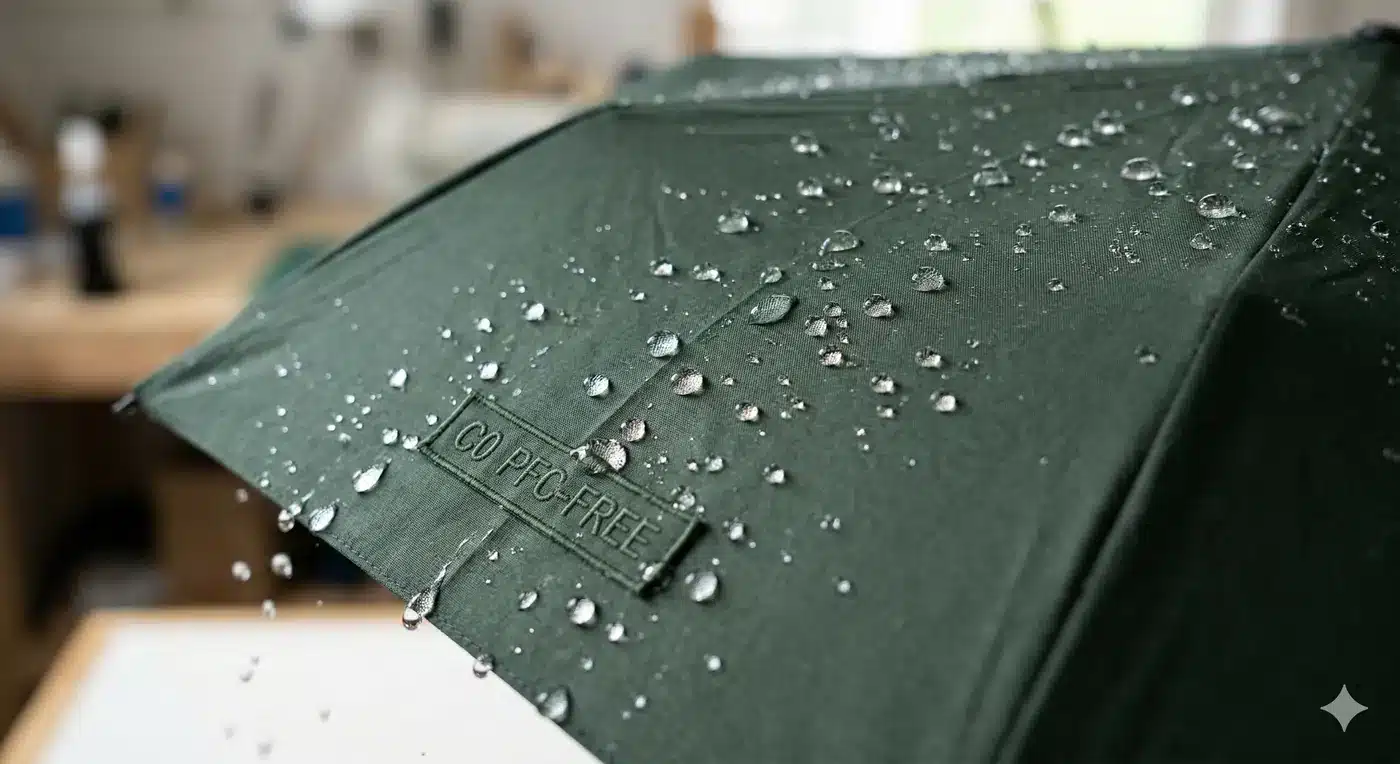
The cloth must meet the practical requirements of the umbrella. Discuss weight, fabric, coating, water repellency, color, printability, odor and processing. A choice of material that sounds good but prints poorly, discolors quickly or is not tight on the frame can reduce the useful life.
Request a physical material or product sample. View it in normal light, rub the surface, check the printing and open and close the product several times. Also assess whether the cover may bear the same material claim or has a different composition.
Combine material with a suitable construction
A long service life depends on the frame, ribs, shaft, runner, springs, ends, seams and handle. Specify these components instead of just using terms like “windproof” or “premium.” If a performance claim is important, agree how it will be tested and what limit will apply.
A stronger construction can use more material, but also last longer. The right decision depends on use, weight, transport and price. A compact giveaway umbrella and an everyday storm umbrella do not have the same optimal composition.
Choose handle and details carefully
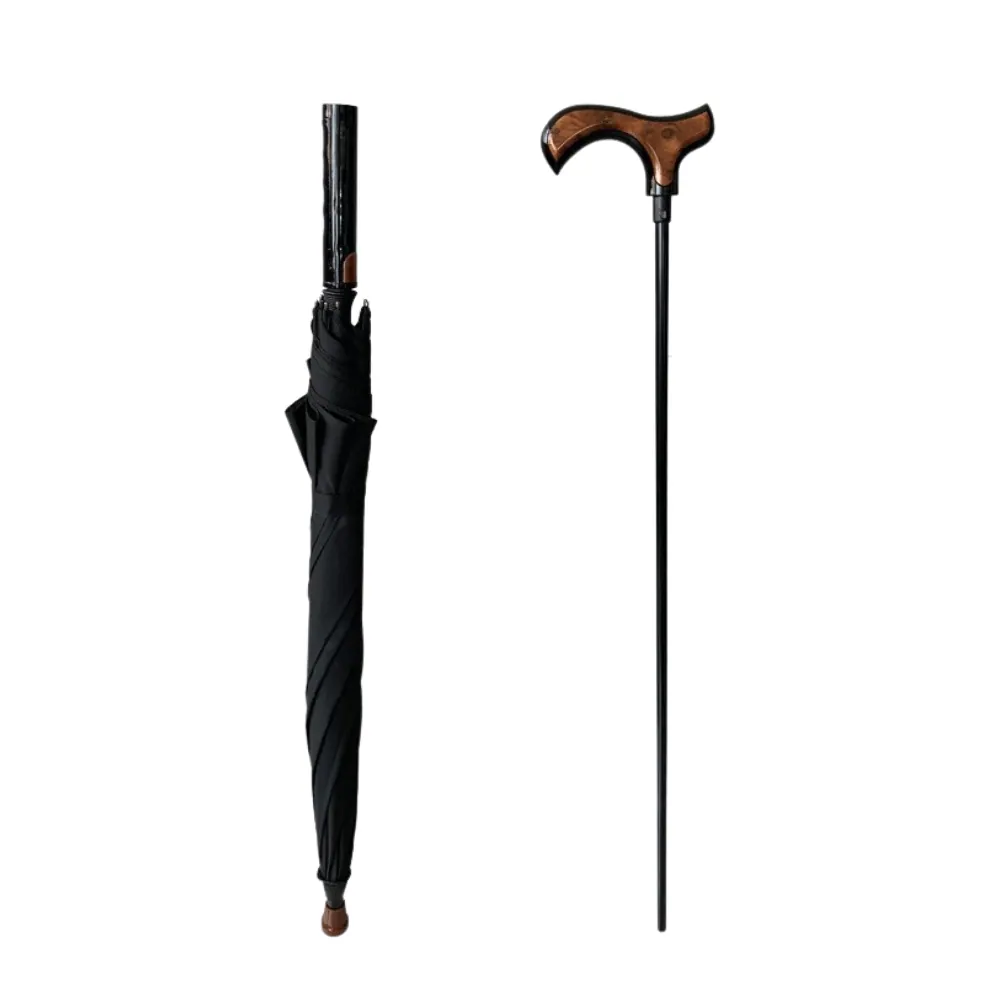
A wooden or bamboo handle can provide a natural appearance, but still needs to be assessed for origin, finish, moisture behavior, attachment and comfort. Avoid the assumption that a natural-looking part automatically has a lower overall environmental impact.
Also view metal and plastic parts, paint, glue, wrist strap, cover and label. The best choice is a coherent product with an honest claim, not a collection of green signals without evidence.
Include logo and printing in the assessment
A sustainable umbrella is often also a brand carrier. Determine logo size, colors, position and printing technique. Ask how the ink or transfer behaves on the chosen recycled canopy fabric. A proof may be required to assess opacity, edges, color and adhesion.
Limit unnecessarily large printing surfaces if they do not add communication value. A well-placed logo on one or two panels can be more effective than a complex all-over print, depending on campaign and use.
Make environmental claims specific and verifiable
The European Commission’s guidance on green claims emphasizes robust, scientific and verifiable substantiation. Avoid broad words such as “environmentally friendly”, “green” or “planet friendly” without definition. Instead, state exactly what you can prove, such as the documented recycled content of the canopy fabric.
Save the product specification, supplier declaration, certificate details, test reports and approved wording with the same SKU. Marketing should not promise more than the technical file supports.
Organize sample and quality control
The sample must represent the agreed material and color combination as best as possible. Check dimensions, weight, opening and closing, locking, frame, fabric tension, seams, printing, handle, cover and packaging. Record deviations in writing.
Verwenden Sie die Checkliste zur Qualitätskontrolle von Regenschirmen as a base and add material documentation and claim control. Agree which sample will be used and who will release the shipment.
Optimize packaging and logistics
Determine if an individual sleeve, bag, box or card is really necessary. Less packaging may make sense, but the product must remain protected during storage and transport. Define quantities per box, marking, barcode, color range and any pallet requirements.
Also calculate the logistical difference between a compact umbrella and a large straight or golf umbrella. Product volume can greatly influence the overall impact and costs.
Don’t forget safety and traceability
Sustainability does not replace product safety. The Verordnung (EU) 2023/988 über die allgemeine Produktsicherheit applies since December 13, 2024. Importers should determine with competent advisors what risk analysis, identification, responsible economic operator and traceability are required for their product and sales channel. This article is not legal advice.
Procurement brief for sustainable printed umbrellas
- Purpose: retail, promotional gift, personnel, event or hospitality.
- Product: for printed umbrellas, specify the folding, straight or golf model, size, opening mechanism and desired weight.
- Claim: exact part, recycled portion and required supporting documents.
- Material: cloth, coating, frame, shaft, handle, cover and packaging.
- Branding: when printing umbrellas, the logo, colors, position, printing technique and proof are all in the same briefing.
- Quality: sample, acceptance criteria, inspection and document control.
- Planning: volume, repeat order, destination and desired delivery date.
Häufig gestellte Fragen
Is RPET automatically more sustainable?
Not as a separate claim. Assess recycled proportion, origin, documentation, product quality, useful life, packaging and logistics together. A weak product with RPET can be quickly replaced.
Can I call an umbrella “eco-friendly”?
Use broad claims only if they are appropriate and firmly substantiated. Specific, verifiable formulations about material and proportion are usually clearer for the buyer and end user.
Is a bamboo handle enough evidence?
No. A natural appearance says nothing about the rest of the product or its overall impact. Check provenance, finish, attachment and the full product specification.
Where can I find more purchasing information?
View the sourcing FAQ for custom umbrellas und die deutsche Einkaufsratgeber.
Nächster Schritt
If you want to source printed umbrellas or compare wholesale suppliers, send Ark Umbrella the intended use, material claim, model, quantity, logo, packaging, evidence requirements and delivery plan. The team can then discuss feasibility, the sample route, a project-specific minimum quantity and quotation.