
Prepared by the Ark Umbrella sourcing and production team. Last reviewed: 22 August 2026.
직접적인 답변: Pongee and polyester are not true opposites. In umbrella sourcing, polyester identifies the fibre family, while pongee usually describes a fabric construction, texture or commercial finish. A canopy sold as “pongee” is often made from polyester yarn. Buyers should therefore specify fibre composition and fabric construction as separate fields, then verify coating, weight, density, color and performance.
This distinction matters because two suppliers can both quote “190T polyester pongee” yet deliver fabrics that differ in yarn size, mass per square metre, surface feel, dyeing, coating and water resistance. Ark Umbrella works with fabric umbrellas through printing, sewing and canopy assembly, so our practical recommendation is simple: buy a controlled fabric specification and approved sample, not a name alone.
Are pongee and polyester the same material?
They can describe the same canopy from different angles. “Polyester” answers the question “what is the yarn made from?” “Pongee” in an umbrella quotation usually answers “what fabric style or hand feel is being offered?” The word pongee has older textile meanings, but modern umbrella trade usage is not a reliable fibre-composition declaration.
For this reason, do not replace the composition field with “pongee.” Ask the supplier to state, for example, polyester fibre, nominal fabric count, yarn specification if critical, mass in g/m², dye or print route, face/back finish, water-repellent treatment and any PU, black or silver coating.
Pongee vs polyester umbrella fabric: practical comparison
| Buying question | Pongee wording | Polyester wording |
|---|---|---|
| What it tells you | Trade construction, surface or finish description | Fibre/polymer family |
| Can both appear on one spec? | Yes | Yes |
| Does it prove quality? | No | No |
| Useful supporting fields | Count, yarn, weight, weave, finish | Composition percentage, recycled/virgin status, color and tests |
| Main purchasing risk | Different suppliers use the term differently | Generic composition hides construction and finish differences |
Why pongee is common in custom umbrellas
Buyers often select polyester pongee because it can provide a smooth presentation, controlled drape and a refined hand suitable for folding, straight and golf umbrellas. It also supports many solid-color and printed programs. Those are common commercial outcomes, not guaranteed properties of every roll bearing the name.
The finished result depends on yarn, weaving, dyeing, heat setting, water-repellent chemistry, coating, print process and sewing tension. A premium-feeling sample cannot be reproduced reliably if the purchase order only says “pongee fabric.”
Which fabric properties should a buyer compare?
- Composition: state polyester or another fibre, and identify recycled content separately where relevant.
- Construction: record nominal count, yarn details and weave or trade construction.
- Mass: use g/m² because thread count does not reveal fabric weight.
- Appearance: approve color standard, gloss, texture, show-through and panel-to-panel shade.
- Water performance: distinguish surface wetting from resistance to penetration.
- Mechanical performance: consider tear, breaking strength and seam behavior for the intended umbrella.
- Coating: specify side, type, color, coverage and any UV or light-blocking claim.
- Print compatibility: approve ink system, artwork, registration, color and adhesion on the actual fabric.
그만큼 ASTM textile standards list is useful because it treats fabric count, mass, tear and breaking strength as different measurements. Likewise, ISO 4920 measures resistance to surface wetting but explicitly does not predict rain penetration, while ISO 811 addresses water penetration under hydrostatic pressure.
How fabric choice affects printing and production
A solid-dyed corporate canopy, a full-panel digital print and a black-coated sun umbrella do not impose the same requirements. Print density can change hand feel; coating can alter needle behavior and panel folding; dark colors can reveal chalk marks or abrasion; and very light constructions can show frame shadows.
Use the intended production route when approving the sample. Ark Umbrella’s custom umbrella guide explains why artwork placement and physical proof approval should be part of the sourcing schedule, while the 우산 품질 관리 체크리스트 covers observable canopy and assembly checks.
How Ark Umbrella controls a fabric brief
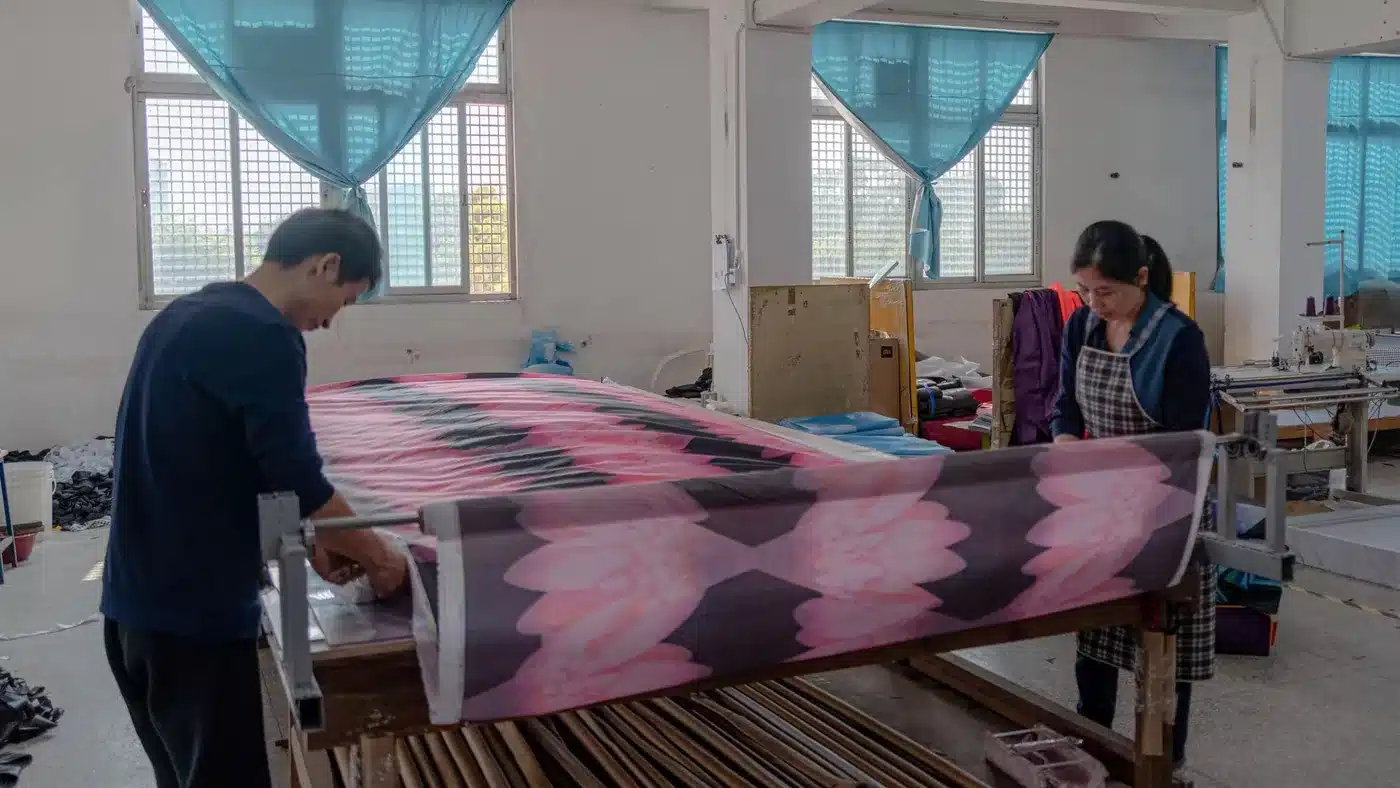
Ark Umbrella was established in 2010 and operates two fabric-umbrella production lines plus a separate POE line. For a fabric project, the team can discuss canopy type, finish, logo method, sample approval, sewing and packing as one specification. The company photo archive includes fabric printing, sewing and canopy-assembly work rather than only finished-product renders.
This does not mean one fabric is automatically suitable for every market. MOQ, shade tolerance, coating availability, print method, testing and lead time must be confirmed for the actual order. Start with the Ark Umbrella manufacturer profile and send a complete brief.
RFQ checklist: fabric fields to put in writing
- Umbrella style, size and target market.
- Fibre composition and whether recycled content is required.
- Pongee or other construction wording plus nominal count.
- Mass in g/m² and color standard.
- Water-repellent finish and coating specification.
- Required test methods and acceptance values.
- Logo or all-over print method and artwork version.
- Reference swatch, approved canopy sample and change-control rule.
Use the custom umbrella quotation planning guide to keep these fields aligned across sample, price and delivery discussions.
자주 묻는 질문
Is pongee better than polyester for umbrellas?
The question mixes construction language with fibre language. Many umbrella pongees are polyester. Compare the complete fabric specification and tested performance instead of treating the two terms as competing materials.
Does a softer fabric mean higher quality?
Not necessarily. Softness is one sensory attribute. The required result also includes color, print, tear behavior, water performance, coating adhesion, sewing and the way the canopy packs around the frame.
What sample should a buyer approve?
Approve a swatch for color and feel, then a finished pre-production umbrella made with the intended fabric, coating, print and frame. Record the sample version and prevent substitutions without written approval.
출처 및 구매자 참고 자료
- ASTM International textile standards
- ISO 4920 surface-wetting spray test
- ISO 811 hydrostatic-pressure test
다음 단계
Send Ark Umbrella your umbrella type, target composition, construction wording, mass, coating, color, artwork, quantity and required tests. The team can then confirm a project-specific sample route and quotation without relying on an ambiguous “pongee vs polyester” label.