
In the wholesale umbrella industry, “eco-friendly” is often used loosely. But for B2B buyers and brands, true sustainability requires more than just a label. It requires a transparent supply chain and high-performance materials. At Ark Umbrella, we’ve specialized in RPET umbrellas that bridge the gap between environmental responsibility and industrial-grade durability.
This guide is for procurement professionals looking for the facts on RPET material, GRS certification, and how to get the best value from an umbrella factory.
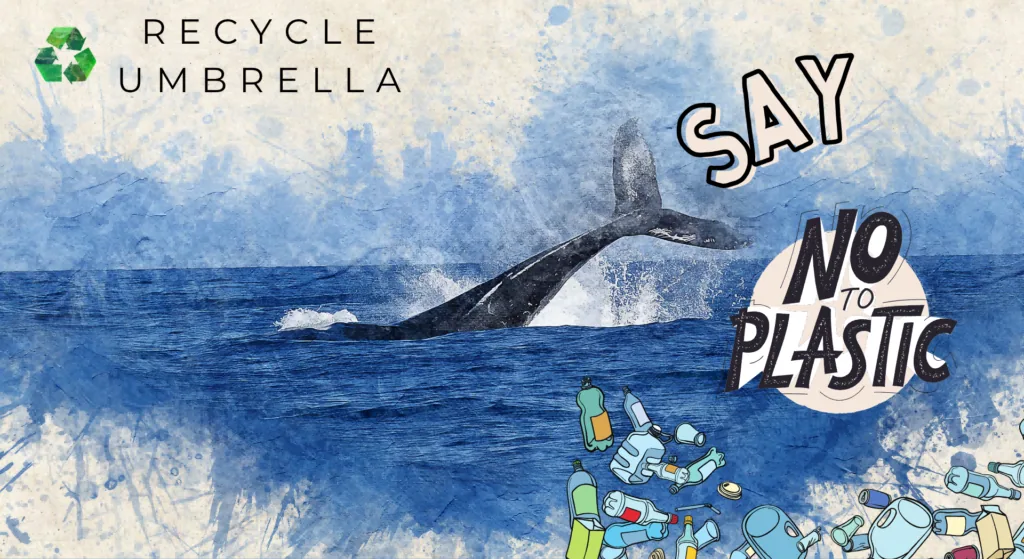
What is RPET? (More than just Recycled Plastic)
RPET (Recycled Polyethylene Terephthalate) is recycled PET. Post-consumer bottles are one possible feedstock; confirm the actual source, recycled percentage and fabric specification for the order.
In a bottle-to-fibre recycling route, collected PET is sorted and processed into material for polyester yarn. Ask who performs each step and how the supplied fabric is traced; this description does not mean Ark Umbrella itself operates a bottle-recycling plant.
Material claim check: Do not infer a bottle count or water-resistance rating from RPET alone. Bottle-equivalent claims need material-mass and recycled-content calculations; canopy performance needs a report for the specified fabric and finish.
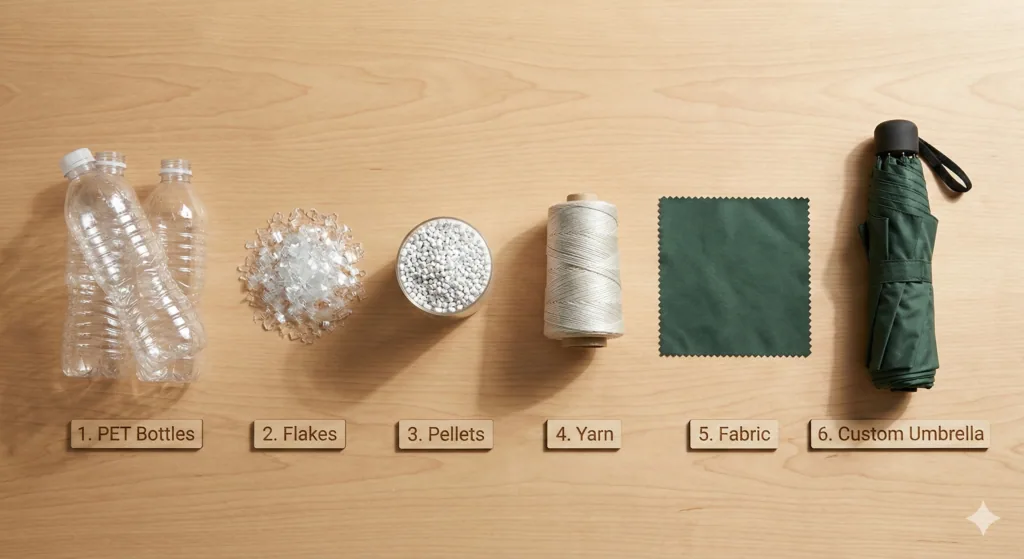
Why Our B2B Clients are Switching to RPET
- ESG Compliance: Corporate and retail customers may request environmental evidence. A lower-carbon claim needs a defined comparison and supporting data; recycled content alone does not establish it.
- Material Consistency: Hand feel, colour and tear performance depend on the selected construction and finish. Compare production-representative swatches and test results.
- Circular Economy: Using recycled materials is the most direct way for a brand to demonstrate its commitment to a greener future.
The GRS Standard: Why It Matters for Your Sourcing
Textile Exchange provides both RCS and GRS for third-party recycled-content and chain-of-custody verification. This section focuses on the GRS (Global Recycled Standard).
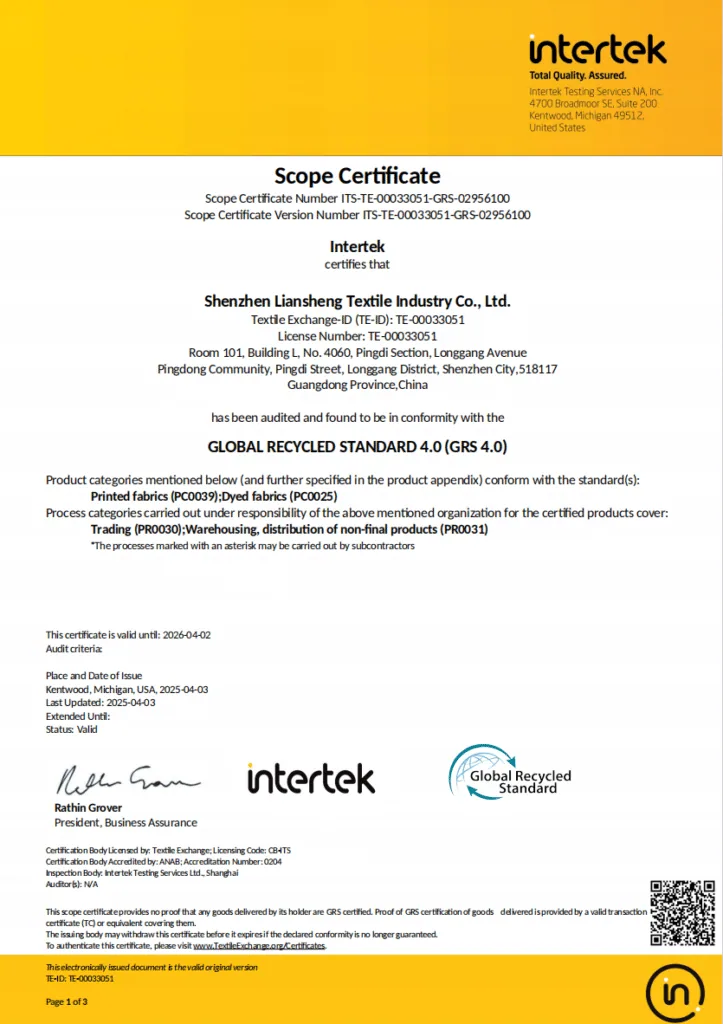
For a GRS order, check the current scope certificate, the parties covered and the documentation for the shipment. A fabric supplier certificate does not certify every finished umbrella. Review:
- Traceability: Verify the documented chain of custody for the fabric and the operations relevant to your order.
- Social & Environmental Requirements: It’s not just about the plastic; it’s about fair labor and chemical management.
- Verified Recycled Content: Confirm whether the specific shipment is eligible for a Transaction Certificate (TC) and arrange the required application through the certified supplier and certification body.
IMPORTANT
The image below names Shenzhen Liansheng Textile Industry Co., Ltd., covers printed and dyed fabrics, and states validity until 2 April 2026. It is a historical fabric-supplier document, not proof of current Ark Umbrella or finished-umbrella certification. Request the current scope certificate and order-specific documentation before making a certified claim.
Featured RPET Models for Wholesale
Here are the specific models we recommend for different B2B needs. Confirm the selected frame, fabric, test plan and approved sample; a material label does not guarantee a particular service life.
1. 3-Fold Auto Open/Close RPET Umbrella
Ideal for daily corporate giveaway or employee gifts.
- Specs: 21-inch canopy, 8 fiberglass ribs (windproof), auto-open/close mechanism.
- Bottle-equivalent claim: Confirm from the canopy mass, recycled percentage and documented bottle-mass assumption; no fixed count is verified here.
2. 23″ Classic Straight Umbrella with Bamboo Handle
A premium choice for museums, luxury hotels, and high-end brand events.
- Specs: 23-inch, steel or fiberglass shaft, natural bamboo handle.
- Eco-Pairing: The natural look of bamboo perfectly complements the recycled story of the canopy.
3. 30″ Double Canopy Golf Umbrella
For golf clubs, automotive brands, and high-visibility marketing.
- Specs: 30-inch, double-canopy (vented for high winds), full fiberglass frame.
- Branding: Massive surface area for full-panel sublimation or screen printing.
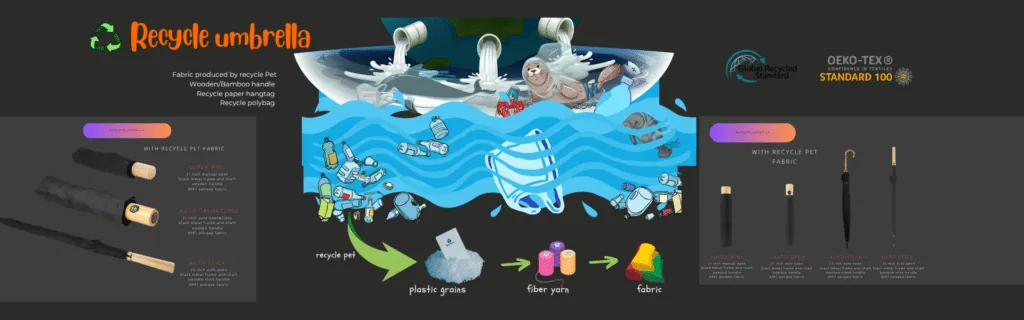
Ark Umbrella RPET umbrella article
Sources and buyer references
The links below are included to help buyers verify the external standards, inspection context or trend references behind this sourcing guidance. They do not replace a project-specific quotation, sample approval or written factory confirmation.
- Textile Exchange RCS and GRS standards – Use this to explain how recycled-content standards support material claim verification.
- Textile Exchange Global Recycled Standard (GRS) – Use this for buyer checks around GRS documentation and supply-chain evidence.
FAQ: What Buyers Ask About RPET
Q: Is it more expensive? A: Request comparable quotes using the same fabric construction, finish, quantity and documentation requirements. No universal RPET price premium is established by this guide.
Q: Can I get custom colors? A: Submit a colour reference and approve a lab dip or physical sample on the chosen RPET fabric. Achievable shade, tolerance, MOQ and cost must be confirmed.
Q: Does the print hold up well on recycled fabric? A: Approve the intended printing process on the actual fabric. Check colour, coverage, adhesion and relevant durability tests rather than assuming identical results across fabrics.
Start Your Sustainable Sourcing Today
Don’t settle for “eco-friendly” claims. Choose a supplier whose current certification scope, material evidence and shipment documents match the claim required for your order.
Get a Quote for Your Custom RPET Umbrellas
RPET Sourcing Evidence Checklist
Ask the supplier which recycled material is used, how recycled content is verified, whether transaction certificates are available for the bulk order and how umbrella performance is checked.
| Evidence item | Buyer question | Why it matters |
|---|---|---|
| GRS certificate | Is the certificate current and linked to the right supplier? | Supports recycled-content and chain-of-custody claims. |
| Transaction certificate | Can a TC be prepared for the bulk order when required? | Helps brands document recycled material in the specific order. |
| Fabric specification | What fabric, coating, color and print method will be used? | Connects sustainability claims with real umbrella performance. |
| Sample approval | Has the buyer checked color, logo, handle, sleeve and opening function? | Prevents sustainability positioning from hiding product-quality issues. |
Buyers planning a sustainable program can compare this article with Ark Umbrella’s RPET umbrella fabric guide, eco-friendly umbrella materials guide, custom logo umbrella guide and contact page for sample and quotation support.
RPET Buyer Validation Workflow
RPET umbrella sourcing should be managed as a validation workflow, not only as an eco-friendly product description. Buyers need to confirm the recycled material claim, the umbrella specification, the sample quality and the documents that will support the final customer message.
The first step is material confirmation. Ask whether the canopy fabric is RPET, whether the supplier can provide GRS-related documentation when required, and whether a transaction certificate is possible for the final bulk order. The second step is product confirmation: canopy size, ribs, shaft, handle, sleeve, logo method and packing should still meet the buyer’s ordinary quality expectations.
The third step is claim control. Match claims about recycled bottles, recycled polyester or GRS-certified sourcing to the evidence available for your specific order before using them in retail copy.
The fourth step is production alignment. Sustainability should not be reviewed separately from the ordinary umbrella specification. Buyers still need to approve the frame, canopy stitching, logo printing, sleeve, handle and carton packing. A recycled canopy is only useful to the buyer if the finished umbrella also meets the expected retail or promotional quality level.
Buyers can use this workflow during supplier comparison by asking every factory the same evidence questions. Which recycled fabric is quoted? Which certificate or transaction document can support the order? Which sample will show the real logo, handle, sleeve and packing? When each supplier answers the same questions, the buyer can compare value rather than comparing broad eco claims. This makes the final RPET decision easier to defend internally.
| Validation step | Buyer action | Result |
|---|---|---|
| Material claim | Request RPET fabric details and available GRS support. | Clear recycled-content evidence. |
| Product sample | Check fabric hand feel, opening function, logo and packing. | Proof the umbrella works as a real product. |
| Order document | Save certificate, quote, sample approval and carton plan. | Reusable evidence for bulk order and reorder. |
| Marketing wording | Keep sustainability claims tied to documented material facts. | Lower risk of overclaiming. |
For related planning, compare the RPET fabric guide, eco-friendly umbrella materials guide, custom logo umbrella guide and quality control checklist before finalizing the brief.
Related sourcing resource: For sustainability-driven sourcing, Ark Umbrella’s umbrella manufacturer in China guide explains OEM/ODM capability, MOQ planning, material coordination and export support for branded projects. For active RPET programs, send a sourcing brief or contact Ark Umbrella for a quote review.
Pingback: Eco-Friendly Umbrella Materials for B2B Buyers
Pingback: Why Choose Ark Umbrella as Your Custom Umbrella Factory